What organic shoppers are never told about the 25+ substances still permitted on “organic” produce. And the science-backed answer quietly changing American kitchens.
If you read every EWG Dirty Dozen update, pay $9 a pound for organic strawberries, and rinse everything twice because you believe the label means chemical-free — there is something the organic produce industry has never told you. It involves the federal definition of “organic.” It involves the conventional farm next door. And it involves why the rinse-and-soak routine clean-eating households have relied on for years has not been doing what they thought it was doing.
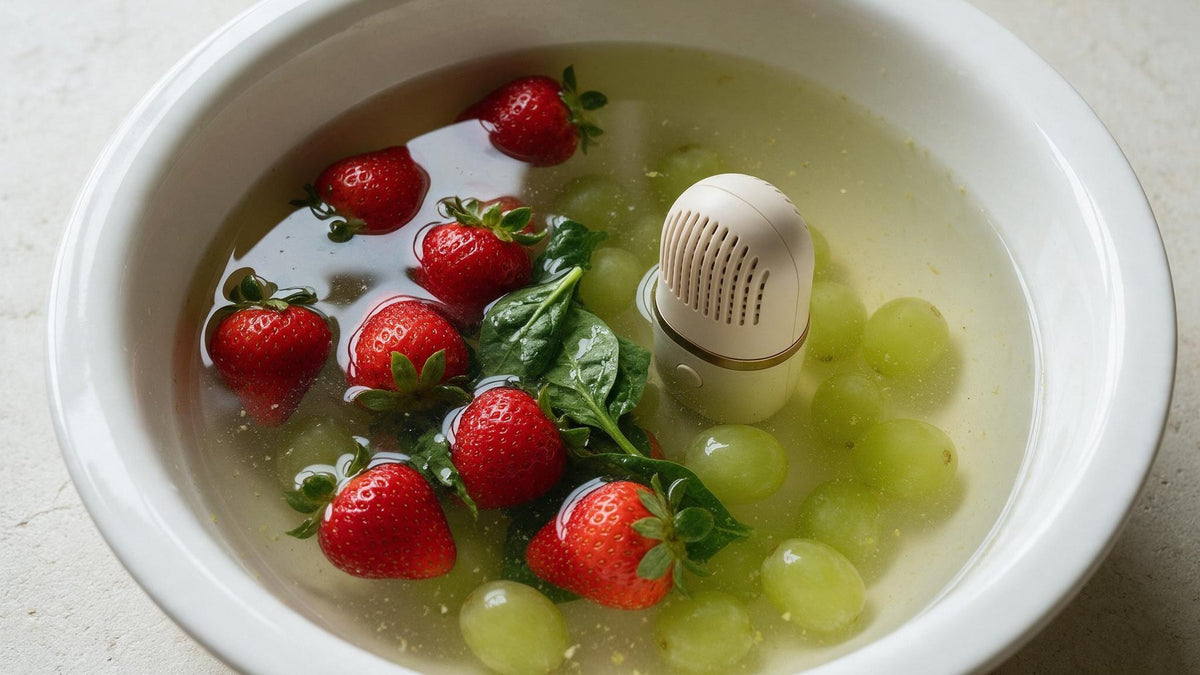
We ran the test ourselves. Here’s what the water looked like.
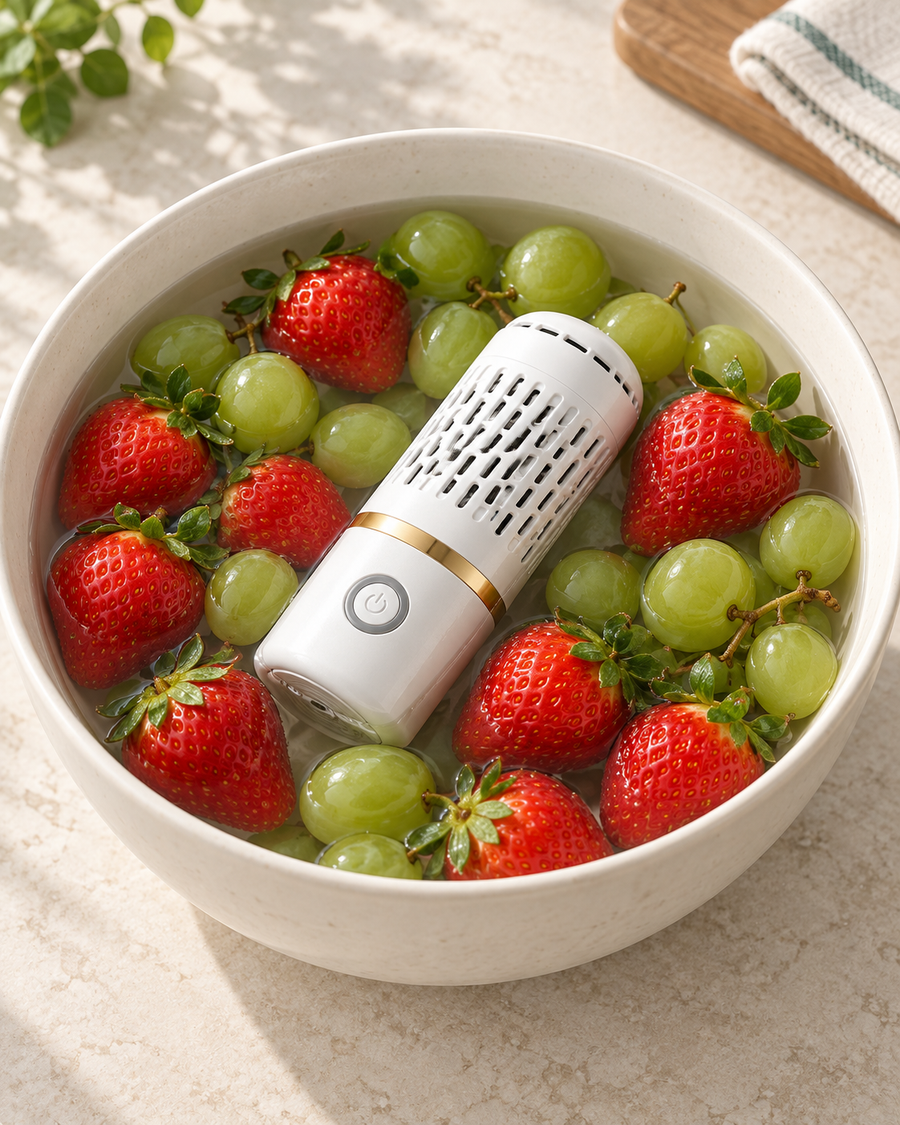
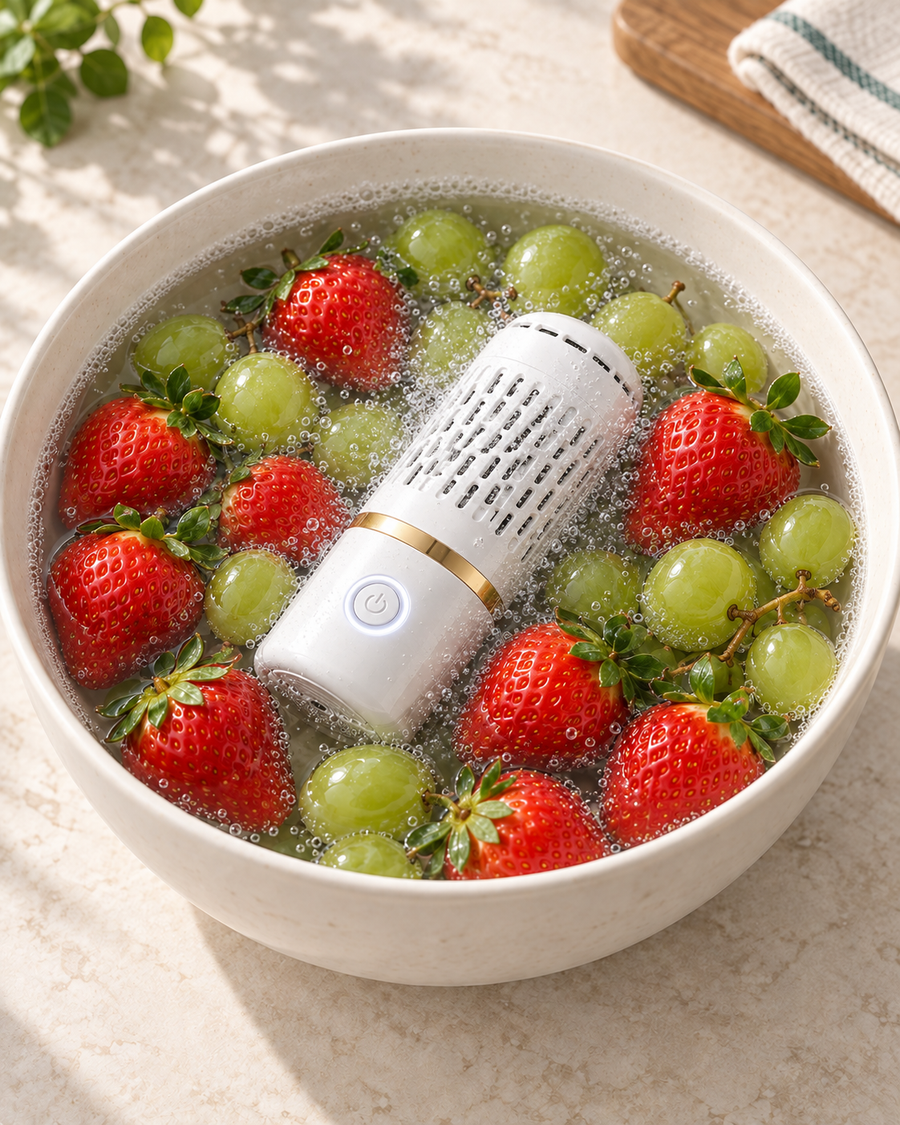
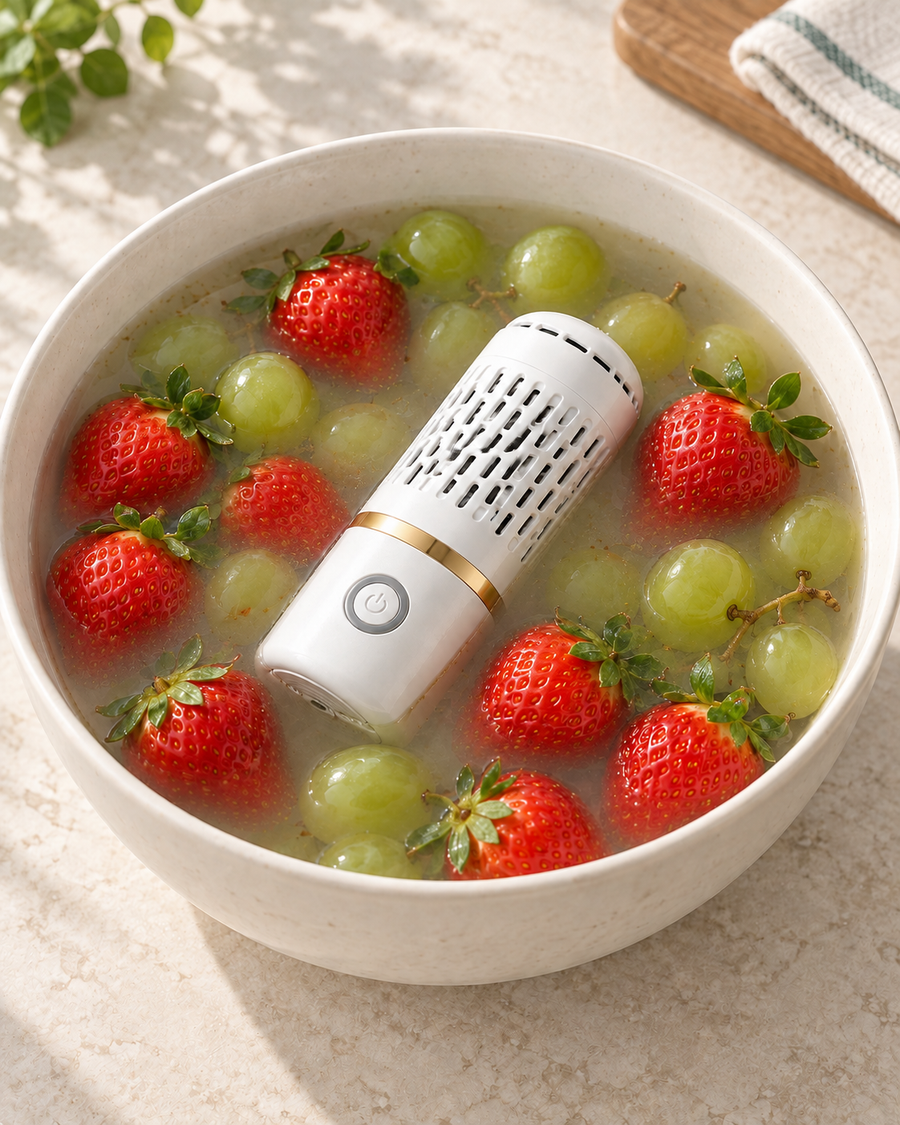
We took a batch of organic strawberries and grapes, washed the way most people wash them: a quick rinse under the tap. They looked clean. They’d pass anyone’s kitchen inspection.
Then we filled a bowl with plain tap water, dropped in a RYVA Pure capsule, and pressed the button once.
Ten minutes later, the water wasn’t clear anymore.
To be precise about what that shows: cloudy water alone doesn’t identify what lifted off. That’s what laboratory testing is for, and we’ll show you the lab table below. But it demonstrates the core problem in one image: produce that looks clean after rinsing is still carrying things water alone doesn’t remove.
The question is what those things are, why your current routine misses them, and what actually works. That’s the rest of this article.
“Wait — organic produce can still have pesticides?”
Most American shoppers assume the word “organic” on a USDA label means the produce was grown without chemicals. It does not.
The USDA National Organic Program explicitly permits more than 25 substances for use on certified organic crops, including copper sulfate, spinosad, pyrethrins, sulfur and hydrogen peroxide. Several are flagged for environmental or human-health concerns by the Environmental Working Group. Copper sulfate in particular accumulates in soil and plant tissue and is used heavily on organic apple, grape and tomato crops.
That’s the first invisible exposure: the chemicals organic farmers are explicitly allowed to use, which shoppers paying premium prices believe were excluded.

The second is geographic. Federal organic rules require a buffer zone between certified organic land and neighboring conventional fields — a buffer that can be as narrow as a few dozen feet. Wind, rain runoff and groundwater do not respect it. Drift from adjacent conventional farms routinely lands on organic crops. It doesn’t invalidate the certification. It simply ends up on the produce sold at a premium.
The third is enforcement. Most organic farms are inspected once a year, and certifiers are required to residue-test only about 5% of the operations they certify. The label is largely a paperwork certification, not a chemistry certification.
The fourth is the supply chain itself. Even produce grown to the cleanest possible standard passes through packing lines, cold storage, shipping containers and dozens of hands before it reaches the shelf.
This is the context that makes produce preparation a real question for clean-eating households — not a paranoid one.
“Fine. But I rinse mine.”
The instinct of any careful shopper is to wash produce under running water. This handles surface dirt well. But the primary contaminants on modern produce are not surface dirt.
The pesticide problem. Modern agricultural pesticides are formulated to be hydrophobic — water-repelling by design. If a pesticide washed off in the rain, it would offer no crop protection. These compounds bond to the waxy cuticle of produce. When you rinse under the tap, water beads and rolls off without breaking those bonds, however long the rinse lasts. This is true on conventional produce. It is also true of the 25+ permitted substances used on organic produce.
The biofilm problem. Pathogens such as Listeria, Salmonella and E. coli form biofilms: protective matrices anchored in the microscopic pores of produce surfaces. The netting of a cantaloupe, the pores of a strawberry, the stem junction of a tomato — these are reservoirs where bacteria cling against a surface rinse. Scrubbing improves coverage but cannot reach pores smaller than the bristle of any brush.
Peer-reviewed research consistently shows that tap-water rinsing achieves about 25% pesticide reduction or less, regardless of duration [Hao et al., Journal of Food Science, 2011]. For a household paying organic prices specifically to reduce chemical exposure, that is the gap between what is paid for and what is delivered.
“I use vinegar. Or baking soda.”
Informed shoppers go further — vinegar soaks, baking soda solutions, commercial produce sprays. Each has a rational basis. Each has specific failure modes.
Vinegar (acetic acid) can reduce surface bacterial counts, but needs 10 to 30 minutes of contact time to do anything meaningful. It does not penetrate biofilms well, does little against mold spores and viruses, and cannot break the bonds of hydrophobic pesticides. The acid smell lingers, and delicate fruit picks up an aftertaste that defeats the point of buying premium produce.
Baking soda is the most-studied home method and does outperform tap water and bleach. A 2017 University of Massachusetts study in the Journal of Agricultural and Food Chemistry found it the most effective of the three methods tested. But the same research revealed a critical limit: even after the full 12-to-15-minute protocol, up to 20% of one pesticide tested had already penetrated into the apple peel and could not be removed by any surface wash [Yang et al., 2017].
Commercial produce sprays are mostly surfactants — essentially soaps. The FDA explicitly advises against washing produce with soap or detergent because porous skins can absorb it. Studies have found most commercial washes perform no better than plain water at removing pesticide residues.
Switching grocery stores resolves nothing. Whether the bag comes from Whole Foods, Sprouts, Fresh Market or Trader Joe’s, it was grown on the same network of certified farms, under the same federal rules that permit 25+ substances and accept drift. The label is identical because the underlying agriculture is identical.
“So what actually works?”
The food-processing industry solved this problem decades ago. Commercial operations — including the suppliers that wash, cut and bag the organic salad greens sold at premium grocers — rely on a technology called electrolyzed oxidizing water (EOW), produced through electrolysis.
When a low-voltage current passes through water containing dissolved chloride (ordinary tap water carries enough), two powerful agents are generated: hypochlorous acid (HOCl) and hydroxyl radicals (·OH).
HOCl is the same compound human white blood cells produce to destroy invading pathogens. It carries no charge, so it passes through the cell walls of bacteria far more efficiently than the hypochlorite in bleach, at a fraction of the concentration. It is non-toxic to human tissue, leaves no harmful residue, is approved by the FDA for direct contact with produce, and after the cycle reverts to ordinary water and trace salts.
Hydroxyl radicals attack the carbon bonds of pesticide molecules directly. They break the ring structures of compounds like chlorpyrifos and degrade the backbone of glyphosate into water, carbon dioxide and inorganic salts. They do the same to the natural-source pesticides permitted on organic produce, including spinosad and pyrethrins.
At the same time, electrolysis generates micro-bubbles that lower the water’s surface tension, carrying the oxidizing agents into the microscopic pores and crevices that scrubbing cannot reach.
The chemistry does not distinguish between “conventional” and “organic” compounds. It distinguishes between pesticide molecules and food.
Organic is a farming standard. This is a cleaning step.
“Sounds like a gadget claim. Show me the research.”
Electrolyzed water is published science, not a marketing invention.
A 2011 study in the Journal of Food Science by researchers at China Agricultural University found electrolyzed water reduced pesticide residues on fresh spinach by 59 to 86% depending on the compound, outperforming tap water and detergent in every category. Critically, the treatment did not reduce vitamin C content — the nutrition clean-eating households are trying to protect was preserved.
A 2024 study in Molecules tested electrolyzed water generated by consumer kitchen devices and confirmed significant pesticide reduction across several produce types — the first study on real home devices under everyday conditions, not just industrial equipment.
A 2017 study in Food Chemistry tested removal of diazinon, cyprodinil and phosmet from spinach, snap beans and grapes: electrolyzed oxidizing water outperformed bleach, commercial produce washes and distilled water, with no effect on texture or color.
What independent laboratory testing shows
The capsule inside RYVA Pure was tested by an accredited independent laboratory in Switzerland under controlled conditions: 2.5 liters of water spiked with each pesticide, one 10-minute cycle, results measured before and after.
| Test item | Before (mg/L) | After (mg/L) | Removal |
|---|---|---|---|
| Glyphosate | 9.60 | <0.001 | >99.8% |
| Chlorpyrifos | 1.894 | <0.001 | >99.9% |
| Dichlorvos | 1.442 | <0.001 | >99.8% |
All three pesticides dropped below the laboratory’s detection limit after a single 10-minute cycle.
Why these three: glyphosate is the active ingredient in Roundup, classified by the WHO’s cancer agency as a probable human carcinogen. Chlorpyrifos is an organophosphate insecticide linked to neurological harm and one of the most commonly detected insecticides on fresh produce. Dichlorvos is a neurotoxin banned in several countries.
The same oxidizing chemistry is documented against the pathogens most often traced to contaminated leafy greens, berries and pre-cut salads: peer-reviewed studies report reductions of up to 99.9% of E. coli, Salmonella and Listeria on produce treated with electrolyzed water [Huang et al., Food Control, 2008].
From a lab in Switzerland to a bowl on a kitchen counter
For decades, this electrolytic process existed only at industrial scale, with equipment too large and expensive for a home. That has changed.
The same electrochemical process has been miniaturized into a capsule that sits in a bowl. Placed in tap water with ordinary produce, RYVA Pure generates the same chemistry — HOCl and hydroxyl radicals — that commercial food-safety operations have relied on for years.
No expertise. No technique. Produce goes into a bowl of water with the capsule. One press. The cycle runs for 10 minutes. The water — now carrying the lifted residue — is poured away, and the produce gets a quick rinse.
No chemical is added to the food. No residue remains. No vinegar smell. No baking-soda taste. No mushy berries.
Scrubbing moves contaminants around on the surface. Electrolytic purification breaks them down at the molecular level. One relies on physical force and cannot reach pores. The other generates chemistry that goes everywhere the water goes.
“Do normal people actually use this?”
I’m really impressed with this little device. I recorded a video while using it on fruit, and you can actually see particles coming off into the water during the cycle. It’s very simple to use and seems to do a thorough job. I’ve been happy with it so far and would definitely recommend it.
Maria K.· Verified buyer, United States
This little device has been great so far. It’s really easy to use and I could see it working almost right away. I first tested it with a few apples and then started using it with other fruits and vegetables too. It felt a little strange putting the whole thing under water at first, but it’s completely waterproof and worked perfectly.
Brenda· Verified buyer, United States
Have been looking for this for a long time. Easy to charge and the base being wireless helps so to keeping it charged when not in use.
Ava C.· Verified buyer, United States
The pattern across households is consistent. A parent who has been reading EWG reports for years, switching grocery stores looking for the cleanest option, rinsing strawberries under the tap with the quiet feeling that it isn’t enough — drops the capsule into a bowl and watches the water change over a batch of organic produce they paid eleven dollars for.
What can honestly be said, beyond the lab data: households that adopt this as their final prep step describe the same outcomes. The daily anxiety of meal prep eases. The cycle of switching grocery chains looking for “the clean one” ends, because the cleaning now happens at home, not at the store. Children eat more produce, because parents stop fighting them about washing. And the grocery bill — which had often crept past $400 a month chasing organic premiums in every category — frequently comes down, because conventional produce in many categories can now be treated at home to a higher standard than the organic that was costing triple.
“Why can’t I just buy the $25 one on Amazon?”
You’ve seen them — capsule-shaped washers on marketplaces for $25 to $40, many sellers, same shell. Marketplace listings in this category average 3.7 stars, and the most common return reason is “doesn’t work.” The shape is the same; what is inside is not.
If a cheap pod turns the water brown or rusty within seconds, that colour is often the electrode itself corroding — not residue leaving your food. Many low-cost pods use iron or stainless-steel electrodes that dissolve during the cycle. Shoppers saw the rust, learned from chemistry forums that it was their own device dissolving into the food, and wrote off the whole category. That early wave of junk is the reason most food-safety writers haven’t covered electrolytic purifiers yet — the technology was never the problem; the electrodes were.
| The $25 capsule | RYVA Pure | |
|---|---|---|
| Electrode | Stainless steel on most low-cost pods; can corrode into the water | Titanium electrode that does not rust: the standard used in industrial food processing and water treatment |
| What you see in the water | Often brown or rusty within seconds | Fine white micro-bubbles, then cloudy water as residue lifts |
| Charging | Cable only; cycles per charge rarely stated | Wireless charging base + USB cable, 25+ cycles per charge |
| Proof | Listing claims | Published research cited, accredited third-party lab results, visible results |
| After the sale | Marketplace seller, 30-day window at best | RYVA support, 60-day money-back, 1-year warranty |
| Price | $25–$40 | $79 |
The result is a device that does at $79 what the $150-to-$190 competitors do — because the underlying mechanism is the same, and the difference is marketing budget, not chemistry.
The $4,800 wake-up call
The average clean-eating household spends around $400 a month at premium grocers chasing the organic label. Over a year, that is $4,800. Over five years, $24,000. And after all of it, the produce coming home is still subject to 25+ permitted substances, drift from neighboring farms, and a supply chain the label does not mention.
RYVA Pure costs $79, once. That is roughly six days of organic premium spending. After that, every piece of produce — organic or conventional — passes through the same electrolytic clean before it reaches the cutting board.
It is not only about money. It is about what the dollars were buying. Ask shoppers why they pay extra for organic and the number-one answer, survey after survey, is avoiding pesticides. The label does not deliver that. The chemistry can.
This is about closing that gap permanently.
Two futures
The difference isn’t just worried versus safe. It’s mental load versus a simple routine. One future is a system of workarounds you have to think about every day. The other is one button.
Your family deserves the real thing
Right now, RYVA is running its special offer: buy two, get the third pod at half price. Free shipping on every order.
- 2 pods for $129 (save $29): one for home, one for your parents’ kitchen.
- 3 pods for $169 (save $68): the third pod for less than half price — for the sister who has been telling you to relax about pesticides for years.
Every order comes with a 60-day money-back guarantee: run RYVA Pure in your own kitchen for two months, and if the water doesn’t convince you, contact support for a full refund. No forms to fight, no restocking fee. Based on the 4.8-star rating from RYVA customers, you won’t need it.
What customers say
I’ve been using this to give fruits and vegetables an extra clean before preparing them. I still rinse everything normally, but using this afterward feels like an added step that gives me more peace of mind. I just fill a bowl or container with water, add the food, place the device inside, and let it run for around 10 minutes. I’ve tried it with fruits, vegetables, rice, meat, and seafood, so it’s been surprisingly versatile. It’s also lightweight, simple to use, and feels well made.
Mariela· Verified buyer, United States
Shipping was quick and the device arrived working perfectly. Once it starts, you can see plenty of bubbles, which makes it feel like it’s actually doing something. It automatically shuts off after some time, which I assume is part of the normal cycle. The charging cable could definitely be a little longer, but that’s a small thing. So far, it seems useful and I’m happy with it.
Stephanie P.· Verified buyer, United States
Are you kidding? Are you really kidding me?!?! I’m sorry, I don’t know what I can say here better than showing these photos of what I saw tonight! I believe now you know what you should...
Katherin M.· Verified buyer, United States
Thank you very much for the great product that cleaning my fruits, vegetables, sea food and meat. I’m very happy with it as it’s actually cleaning very well and giving me best taste of my food I love. Well recommended to anyone who wants healthier food.
Melissa· Verified buyer, United States
Get the produce purifier clean-eating parents are switching to. Removes pesticides from organic AND conventional produce in just 10 minutes. Titanium electrode. Accredited third-party lab tested. 60-day money-back guarantee.
References
- Qi, Z. et al. (2017). Effectiveness of electrolyzed oxidizing water treatment in removing pesticide residues and its effect on produce quality. Food Chemistry, 227, 154–160. doi:10.1016/j.foodchem.2017.01.086
- Studziński, W. et al. (2024). Removal of Pesticides from Lemon and Vegetables Using Electrolyzed Water Kitchen Devices. Molecules, 29(23), 5797. doi:10.3390/molecules29235797
- Hao, J. et al. (2011). Reduction of Pesticide Residues on Fresh Vegetables with Electrolyzed Water Treatment. Journal of Food Science, 76(4), C520–C524. doi:10.1111/j.1750-3841.2011.02154.x
- Yang, T. et al. (2017). Effectiveness of Commercial and Homemade Washing Agents in Removing Pesticide Residues on and in Apples. Journal of Agricultural and Food Chemistry, 65(44), 9744–9752. doi:10.1021/acs.jafc.7b03118
- Huang, Y.-R. et al. (2008). Application of electrolyzed water in the food industry. Food Control, 19(4), 329–345. doi:10.1016/j.foodcont.2007.08.012
- USDA National Organic Program: 7 CFR 205.601 (allowed substances), 205.202 (buffer zones), 205.670 (residue testing). U.S. FDA: 21 CFR 173.315; Selecting and Serving Produce Safely.
THIS IS AN ADVERTISEMENT AND NOT AN ACTUAL NEWS ARTICLE, BLOG, OR CONSUMER PROTECTION UPDATE. RYVA Pure is a household kitchen appliance, not a medical device. Laboratory results were measured in water under controlled conditions; results on produce vary by type, residue, water quality and cycle time. Individual results vary. RYVA Pure is an extra cleaning step for produce, not a substitute for food-safety guidance from health authorities or your clinician.